

Last night, while watching the Academy Awards, I bet—and lost—$1,000 on Timothée Chalamet to win the Oscar for best actor.
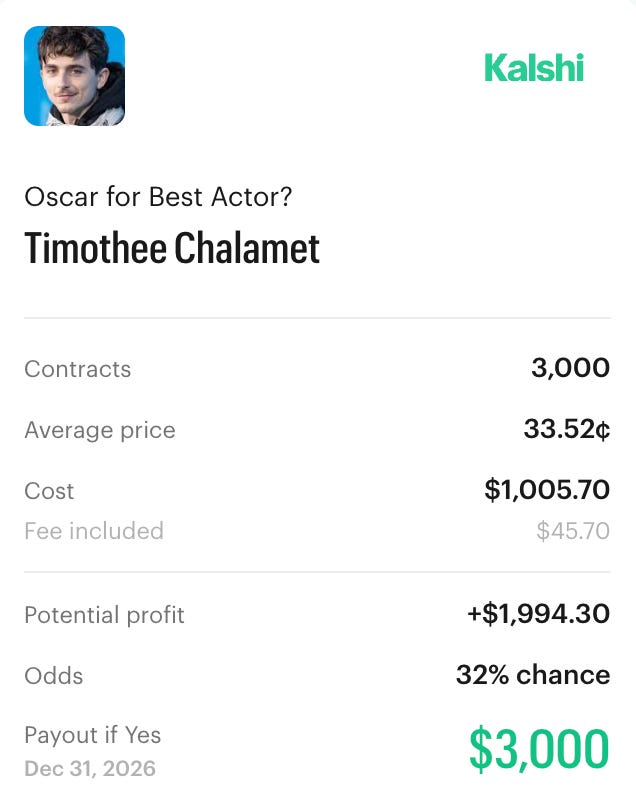
I was not alone.1 Gambling on current events has exploded recently due to prediction markets, platforms where users can trade ‘event contracts’ on everything from Oscar winners to wars (the vast majority of volume is on sports). On Kalshi, the largest prediction market in the US, there was more than $50 million traded on last night’s awards.2
Prediction markets are increasingly being integrated into mainstream media, through both paid deals—Kalshi’s branded ticker across CNN and CNBC’s broadcasts, Polymarket’s odds displayed throughout the Golden Globes—and organic coverage.
Not everyone is happy. Critics see prediction market odds displays as shilling gambling, a Faustian bargain where media companies lend their credibility to betting platforms in exchange for a cut of their viewers’ losses.3 As Judd Legum wrote in December, the partnerships “fundamentally change the nature of news,” turning it from something you watch into something you wager on.
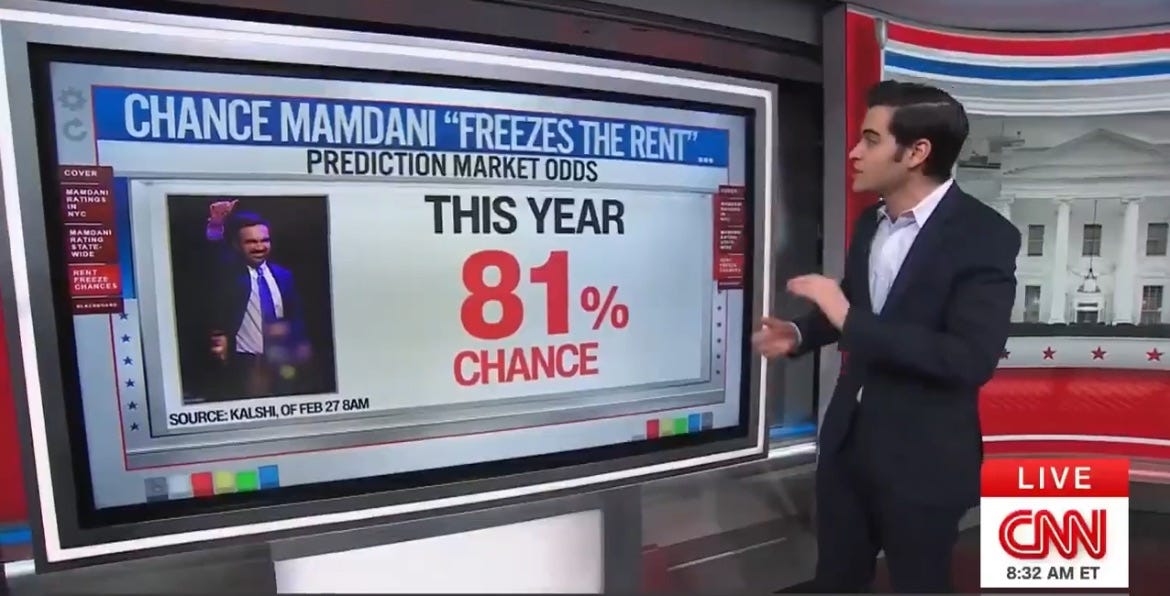
Advocates counter that prediction markets produce useful information and accurate forecasts.4 Prediction markets, they note, outperform pundits, polls, and expert panels, because people bet more carefully with money on the line and because the potential for profit attracts those who know what they’re doing.
Both arguments are fair. Prediction market odds are genuinely informative, and media consumers would benefit from using them to calibrate their beliefs about what is likely, or unlikely, to happen.5 The same is true for sports betting odds, which have been around for far longer and are far more accurate than the talking heads ESPN pays to make predictions.6 Few things annoy me more than a commentator treating a game as a coin flip when betting markets give one team an 80% chance of victory.
But Kalshi didn’t pay for an exclusive CNN partnership to help people think probabilistically. They paid because every time an anchor says ‘according to Kalshi,’ some percentage of viewers are going to download the app and start gambling. The same is true for sports. ESPN hosts aren’t using betting odds to sharpen their analysis; they’re reading ad copy for DraftKings. And the promotion extends well beyond TV—Kalshi generated 5.2 billion digital ad impressions in the first two months of 2026, nearly twice as many as FanDuel, the next most frequent online betting advertiser.7
There’s nothing wrong with putting prediction market odds on television. There is something wrong with prediction markets paying to put themselves on television. But ads, however ubiquitous and annoying, are ads—they try to change your mind, not your environment. As I’ve written before, the real danger with prediction market expansion has always been distribution; these are gambling products that now sit alongside stocks and retirement funds in brokerage accounts.8
This is best epitomized by Robinhood, the gamified brokerage most popular among young Americans. After initially partnering with Kalshi to offer event contracts, Robinhood acquired its own prediction market exchange last year. Contracts are listed on the home screen, one swipe away from retirement accounts and crypto, promoted more aggressively than any asset that might actually make users money. (Below is a video of me logging into Robinhood and betting on Michael B Jordan to win best actor.)
Prediction markets are the fastest growing product in the company’s history, on track to generate $300 million in fees this year. That money comes entirely from users: prediction markets just reallocate money among participants, minus the cut the platform takes. Bettors as a group are guaranteed to lose exactly what Robinhood makes.9
Schwab’s CEO, who called prediction markets “95% sports gambling” and told the Wall Street Journal in December the company “ideally wouldn’t have to” offer them, changed course in January, telling Bloomberg they’re “absolutely open” to adding event contracts. CME Group, the world’s largest derivatives exchange, has partnered with FanDuel to launch contracts that resolve every 60 minutes, on an app designed to mimic FanDuel’s sportsbook.
To place a bet on DraftKings you have to download a gambling app, create an account, and deposit money: a series of steps that requires you to decide you want to gamble. Millions of Americans haven’t made that decision, and never would. But they already have Robinhood. They already have Schwab. The money is there, the account is open, and the bets are increasingly one tap away from their savings.
The industry’s defense is that prediction markets are different from gambling: that they serve a hedging function, like insurance, and produce socially valuable information.10 There’s something to this. Farmers can hedge temperature risk. Small businesses can hedge tax policy. Those are real use cases. They’re also not what’s happening. Sports contracts account for more than 90% of prediction market volume. The platforms know it—which is why marketing is aimed at college students trying to get rich quick, not soybean farmers managing yield exposure.
I watched more of the Oscars last night than I would have otherwise, because I had money on it. I cared about categories I’d never heard of and rooted for people whose movies I hadn’t seen. I texted friends asking their thoughts on Sinners vs Marty Supreme.
Critics worry that gambling promotions in news and sports coverage encourage people to bet more. They’re right, but lots of people are also only watching because they have money on the outcome.11 That’s what makes partnerships between news outlets and prediction markets, or between sportsbooks and media companies, so appealing: gambling platforms get more volume, while media companies get more engagement. In my case, that attention cost $1,000. For the millions of Americans now one tap away from gambling with their savings, it could cost far more.
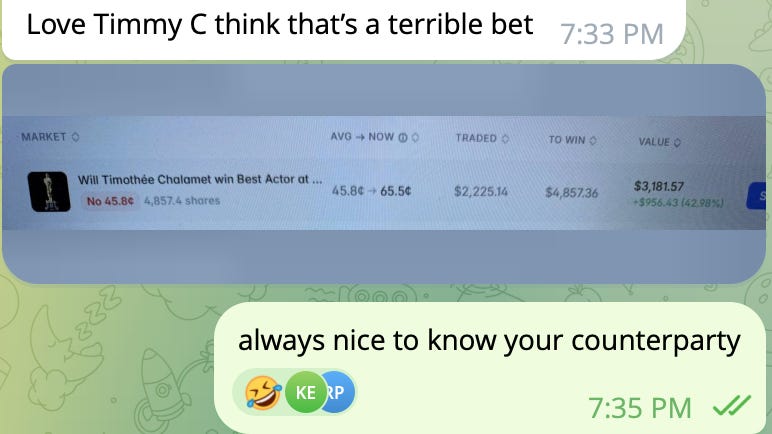
After sending a screenshot of a bet to a group chat, one friend responded with his own wager on Chalamet to not win the Oscar.
It’s important not to equate prediction market trading volume with sportsbook handle, for two main reasons. First is that it’s double counted: since prediction markets connect buyers and sellers, trading volume counts both sides, whereas at sportsbooks the house is the counterparty to every trade. Second, the platforms are filled with market-makers and institutional traders, meaning the % of volume attributable to “normal” Americans is much less than at sportsbooks, where it’s >90%.
To be clear, media companies almost certainly aren’t actually getting a % of user losses—although this was, and in sketchier environments still is, a common betting affiliate deal structure—but they’re referring traders who will almost certainly lose to platforms profiting off fees which is very close to the same thing. This is a very contentious point and prediction market advocates love to wax poetic about how “they don’t care if people win or lose unlike sportsbooks who take the opposite side of your bet” which is kinda true but in reality the platforms run on losers and so it is a distinction without a difference.
The accuracy of prediction markets depends on the liquidity; there is not much forecasting value if the wisdom of crowds has not accumulated. As I told The Athletic in January, “You really have to make the distinction between markets that are highly liquid and markets that are not liquid… prediction markets work when there’s a lot of liquidity. So it’s not fair to attack them for not being truth-seeking mechanisms when I, with one click of the button and not even caring about the money, could wipe out the entire order book.”
I am biased here, as someone who taught a class titled “Behind the Cards and Beyond the Bets: Optimal Decision Making in Gambling and Life.”
Betting markets are honed by millions of dollars in wagers from incredibly smart and informed bettors. They are almost always incredibly accurate, and if someone disagrees and can actually predict things much better, they should go do that and make a bunch of money instead of opining about how inefficient betting markets are.
Kalshi and Polymarket have also marketed heavily on college campuses, paying fraternities to sign up users, sponsoring student influencers, and seeding clubs with cash. The Wall Street Journal recently reported on the phenomenon, which included some egregious examples. One Polymarket fraternity partnership raised $30,000 in two weeks which was used to throw a party. Both companies tried to recruit a 15-year-old video game streamer as a marketing affiliate. Kalshi ended the arrangement after a week, with one employee writing, “Yo brother, legal team confirmed that we can’t work with minors rn. Kinda sad tbh.” Sportsbooks have ran similar campaigns on college campuses, although prediction markets are 18+ instead of 21+ so they are better suited to capture college students as users.
While ads encourage more people to gamble, the lack of friction from brokerage integration will, in my opinion, lead to far more people gambling dangerously and losing detrimental sums of money.
This is particularly egregious on Robinhood, where users are only allowed to “take” orders, not “make” them like they are on most exchanges. This allows Robinhood and their partnered market makers to be the counterparty to all their users’ trades, both maximizing their profit and ensuring users get horrible prices because there is no competition to offer a better price than what Robinhood is offering (which is the entire point of prediction markets).
For an amusing (and frustrating) conversation on what markets prediction markets are allowed to offer, check out the recent Odd Lots with the new chairman of the CFTC, where he is pressed on whether roulette spins could be considered commodities.
Lots of people believe sports leagues are in bed with sportsbooks because they’re paying them a ton of money, but that’s only part of the story; the biggest reason is that people who bet are far more likely to watch games, which drives up the value of broadcast deals, which is where leagues make most of their money. This is increasingly true as the product of certain leagues decreases. As one bettor recently told me, “ain’t nobody watching a Wizards or Jazz game unless they’re related to a player or got money on it.”
ALWAYS enjoy your words...Cheers...Ben Eckstein...America's Line...
Who wants to TRADE on the Oscars! TRADE Isaac!