

Last Sunday, Netflix released Instadocs: The Prediction Games, a 36-minute documentary on prediction markets. I appear briefly, drinking Capri-Sun and representing the sharps—the traders who win.1 The production focused on the two largest prediction markets, Kalshi and Polymarket, and featured interviews with the CEOs of both companies, the chairman of the CFTC, and others.
Drawing on a framework from James Surowiecki, author of The Wisdom of Crowds, the film highlights three main problems with prediction markets: insider trading, gaming the system, and altering reality. It investigates politicians trading on inside information, an alleged botting scheme on Spotify, and angry gamblers threatening a journalist in an effort to change his reporting on the Israel-Iran conflict.
The documentary is a useful primer: well-made, briskly paced, and fair to skeptics. But it missed opportunities to go even further, in two main ways. The first is its lack of focus on sports. After noting that sports account for more than 85% of the volume on these platforms—and that the legal battles over prediction markets are almost exclusively about sports contracts—the film mostly ignores sports in favor of political and culture markets and the controversies those markets often create.
Sports prediction markets cannot be evaluated in isolation from traditional sportsbooks. Their strongest argument has never been that they uncover truth or help people hedge meaningful risk. It is that they offer a cheaper, fairer, and less exploitative version of a product tens of millions of Americans already use.2 The relevant comparison is not between prediction markets and a world without betting; it is between prediction markets and DraftKings and FanDuel.
The second is that the documentary never says how much money people lose—or that prediction markets require losing traders. The film briefly acknowledges that platforms collect fees, but never quantifies them or returns to the subject.
Unlike the three problems Surowiecki outlined, regular users losing a lot of money doesn’t require bad actors, or even wrongdoing. It’s simply what happens when the platforms work as designed.
The World Cup was the obvious place to address both omissions. Over the course of the tournament, Kalshi processed more than $50 billion in volume, while regular users lost roughly $640 million3, including $80 million on the final Sunday alone.4
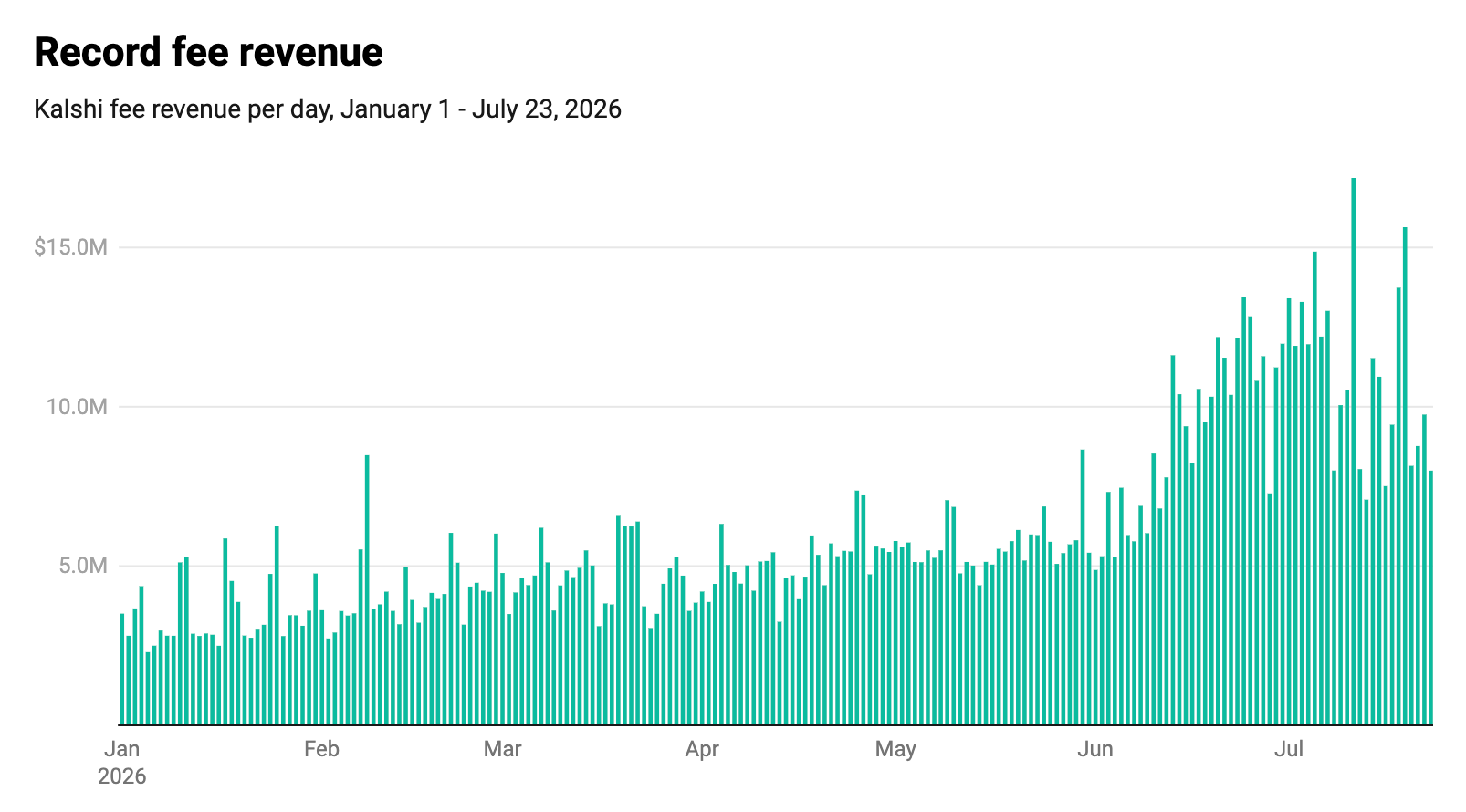
There is nothing inherently wrong with people losing money speculating, whether it’s on sports, Spotify markets, or stocks. For many users those losses represent payment for entertainment, which is a perfectly good trade.
But the central legal fight over these platforms is about whether their contracts are financial products, and the industry’s answer is yes. That claim underpins their availability in states without legal sports betting and their existence inside brokerage apps, a swipe away from index funds and retirement savings.
What’s most dangerous about prediction markets is not their facilitation of insider trading, the ways they can be manipulated, or even how they can change the outcomes they’re supposed to measure. It’s that they’re the latest frontier in a broader shift away from lower-risk investments that build wealth over time and toward higher-risk gambles that usually erode it—products the platforms are pushing and many users are choosing.5 The people on the losing end are too often the ones who can least afford to be, and a generation that saves less and gambles more eventually leaves the rest of society with the bill.
For those interested the segment with me begins at 7:40, and I show up again at 10:40 and 34:00. DraftKings co-founder Matt Kalish described me (I hope affectionately) as a “Kalshi Virgin.” Here is a longer conversation I recorded about my thoughts on the doc and the behind the scenes process.
Part of this was a function of focusing on Kalshi and Polymarket, who are intent on downplaying the importance of sports on their platforms, in part to bolster their legal claims that they are not sports betting. For more on the arguments in favor of sports prediction markets, see my interview with ProphetX cofounder Jake Benzaquen.
Kalshi disputes these numbers, but they are being intentionally obtuse or lying; the numbers are at worst very close to accurate. (Roughly $640 million because takers, an accurate proxy for regular users, lost $288 million and paid about $350 million in fees. An upcoming post will dive into this and other mistruths.)
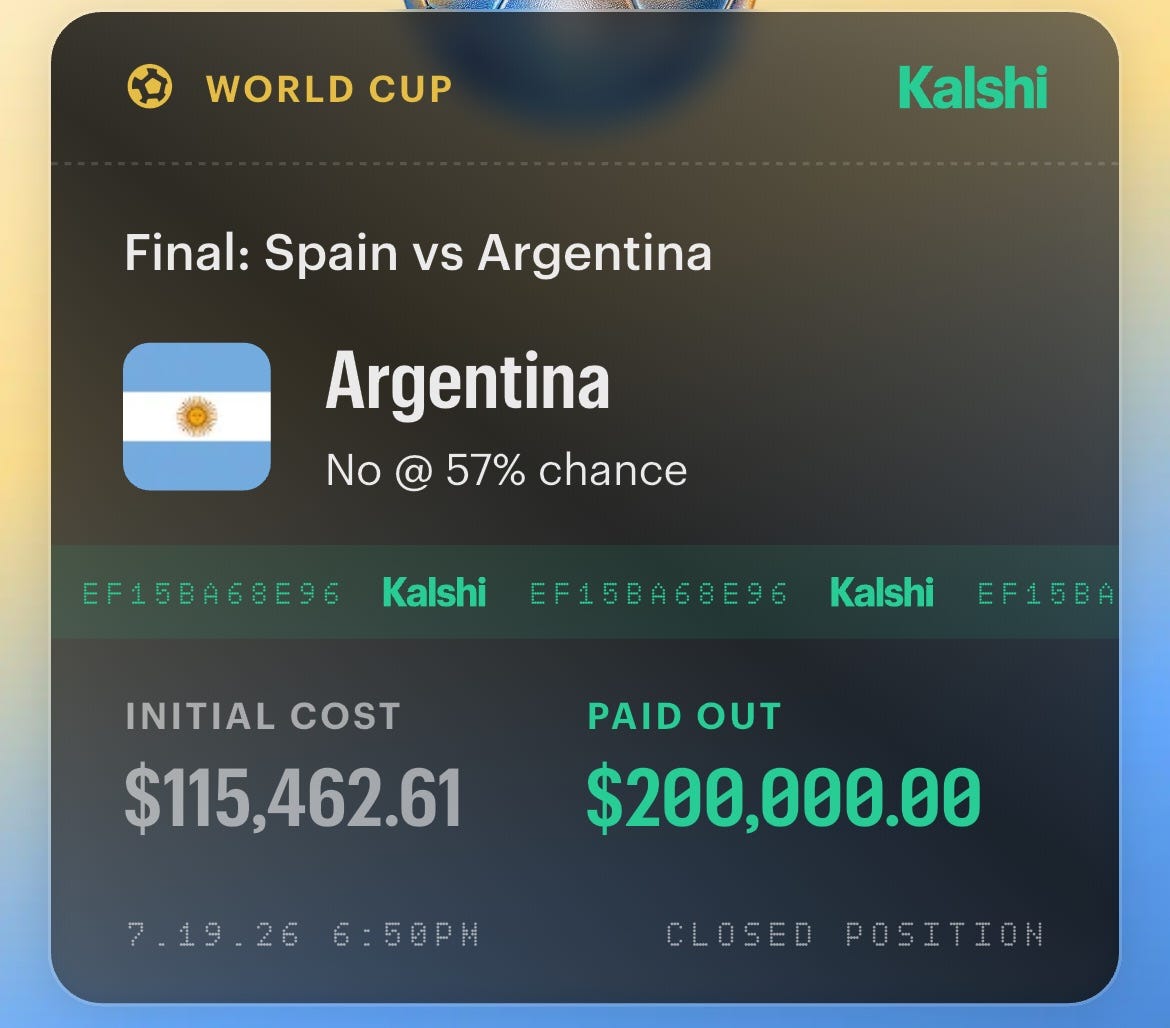
Losses on the final were so massive because the vast majority of regular users bet on Argentina, who lost. Other popular bets by retail users, such as Messi to score and over on the total goals market, also lost. In fact, the retail frenzy on Argentina was so massive that it shifted the price significantly, to the point where traders could bet Spain on Kalshi and bet Argentina on certain sportsbooks and lock in a profit (arbitrage). Kalshi had a such a good price on Spain that basically every sharp I know had massive Spain bets on the platform. I personally had over a $100,000 position on Spain (shown as “Argentina No” on the slip below) on Kalshi.
While there isn’t great evidence on the direct effects of prediction markets in this regard (in part because the companies don’t share much of their data with researchers), there is solid evidence on the effect of traditional sports betting in crowding out saving and investing, and given prediction markets’ brokerage integration and higher resemblance to traditional financial products it seems clear they would have a similar, if not greater effect.
You should look at the McGregor fight for a place retail got smoked as well. I saw retail losing 20m on that, and were paying through bookmaker levels before fees.
Kalshi is about equal (or a touch better) in pricing to bookmakers after fees when flow is small+ balanced, but is much much worse for customers when there is large one directional uninformed flow, as now the MMs aren't going to take on the risk without at least the same edge that bookmakers seek, and then there is the exchange as another mouth to feed.
How have AI agents not snapped up all arbitrage opportunities, or at the very least obvious ones like the World Cup final? Seems like it would be child play to program.