

Seemingly every week, a new Tweet goes viral about how much Americans are betting on sports. These posts often contain half-truths that sound shocking, especially when people conflate handle (how much people bet) and revenue (how much they lose).
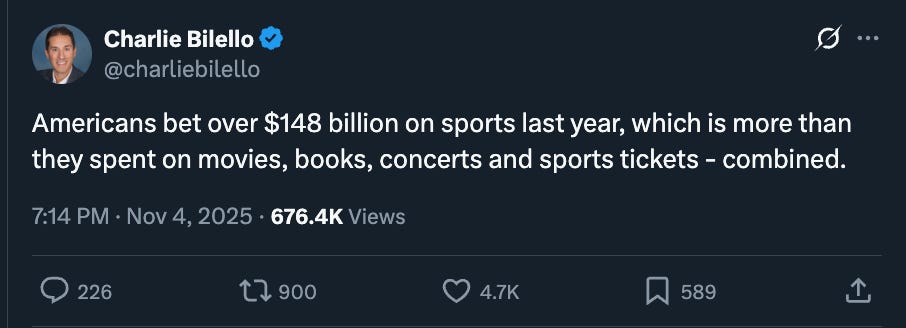
This week’s version is technically correct; Americans did legally wager $148 billion on sports last year, more than they spent on movies, books, concerts and sports tickets combined. But it’s also misleading, because bet and spent measure completely different things.
When you pay $200 for a concert ticket, that $200 is gone. But when you place a $200 sports bet, you sometimes get money back. Of course, in the long run bettors get back less than they put in. In modern sports betting, that amount—the vig, or house edge—is about 10%, meaning for every $100 users bet they lose about $10, and get back $90.
The more apt comparison for this Tweet, therefore, is probably not $148 billion but $13.7 billion, or sports betting revenue—how much users actually lost.1
Yet dismissing the $148 billion as meaningless would also be a mistake. It captures something important about how gambling works on paper versus how people actually experience it.2
When someone places a $100 bet, the math might say they’re paying $10 for entertainment. But that’s only true in aggregate, across thousands of bets. In reality, that person either wins (likely more than $10) or loses their entire $100. There’s no scenario where they lose exactly $10.
That distinction matters. Most entertainment comes with a fixed price tag. Gambling is variable: bets either win or they don’t. The $148 billion in handle represents millions of Americans taking these binary shots. Casinos can ride out the variance because they’re taking tons of bets, and in the long run statistics works. But most gamblers are here for a good time, not a long time.3 They don’t experience a 10% entertainment tax. They experience winning or losing.

This is why both numbers are important. One is the the economic cost, what actually leaves Americans’ pockets for good. The other is the scale of risk Americans are taking, the amount of money they’re willing to put in play.
I used to play in a poker game where every night started with a coin flip tournament.4 Eight players, single elimination bracket. Everyone anted up $100, and after three rounds of flips, one person would be up $700 while the other seven were down their hundred.5
I once lost twenty weeks in a row.6 Two grand gone on coin flips, despite the math saying I shouldn’t be up or down anything.7 Expected value is tidy, actual results are messy.
Focusing on just one figure misses the point. $13.7 billion tells us what sports betting costs in aggregate. $148 billion tells us what’s actually at stake every Sunday. Both are real, both matter, and neither tells the whole story alone.
The main problem with the conflation of handle and revenue is that people and legislators overestimate the size and profitability of the sports betting industry. Of course, $13.7 billion is a massive amount of revenue. But it’s a lot less than $148 billion, and that $13.7 billion doesn’t include all the costs associated with running a sportsbook. Data, licensing, promotions, marketing, geolocation, app maintenance, transaction fees (when a user deposits $100 to Fanduel, Fanduel might only get $98) and TAXES all cost lots of money; there’s a big difference between how much users lose and how much sportsbooks actually profit (gross gaming revenue vs net gaming revenue). GGR is useful when analyzing how gambling impacts users, but net revenue is more useful when analyzing (and taxing) gambling operators. It is (in my opinion) misguided and bad for everyone that operators pay a federal excise tax on total handle, and that some states seeking to increase gambling taxes are looking to do so on anything other than net profits, because it results in all sorts of bad distortions. But that’s a different post.
This has changed with online gambling, where there’s less friction than at brick and mortar casinos and it’s easier to keep gambling and redepositing. That friction means casino attendees are more likely to go in with a set amount of money they’re willing to lose and stick to it compared to online gamblers.
If a gambler practices responsible bankroll management—they don’t place too much on any one bet—their overall returns, like a casino, will likely converge to what the math dictates. In economic terms, their consumption will be smoothed.
Instead of using actual coins, two players would be dealt a hand face up and we’d run out the cards with no betting. Still a pure 50/50, but more fun.
I know this sounds like pure torture to non-gamblers, but poker games better if people are in a more “gambly” mood and this is, in my experience, a pretty good way to get those juices flowing.
A friend recently told me about a poker game with a modified version of this, where everyone got one hand and they ran out the cards once. He believes that while the actual poker game wasn’t cheated, the game hosts were rigging this initial flip, as it was incredibly lucrative but far less risky/complex than cheating once the game actually started.
In poker these are known as Sklansky dollars, named after the famous poker player and author David Sklansky. They tell you how much money you expect to win from the pot based on your equity at that point in the hand. If you have a 50% chance of winning $10 your expected return is $5, meaning if you lose and get $0 you “bank” 5 Sklansky dollars. It’s a way for poker players to remind themselves to think in terms of expected value, not one-off results.
The distinction between one off "consumption" and gambling where you sometimes get money back also has the interesting side effect that the same dollar can in some sense be wagered twice.
I don't think it is that useful to do any accounting with this in mind since dollars are fungible and it is not really all that relevant if your next bet came from the proceeds of a previous bet, however in the aggregate assuming all bettors have a fixed budget that they used to bet over a fixed time period, the actual amounts wagered over that time period should be some multiple of the total budget.
This is dead on. Most people outside the card world don’t understand how quiet the real pressure is. It never looks like a movie when it’s happening.